
The Chinese military on Monday started new major drills in the 'middle areas' of the Taiwan Strait amid rising diplomatic tensions with Japan over Taiwan that Beijing claims as its territory.

The Chinese military on Thursday said it has conducted precision strikes over the Taiwan Strait and 'expected results' were achieved, in apparent retaliation to the United States House Speaker Nancy Pelosi's visit to Taipei disregarding Beijing's vociferous warnings.

Chinese leaders, including its generals, will have to weigh whether they can win a war if they ever attack Taiwan and if at all, can they sustain the subsequent devastation, notes Rup Narayan Das.

Following his visit to China, US President Donald Trump has suggested a potential shift in Washington's approach to Taiwan, expressing reluctance to engage in military conflict over Taiwan's independence and cautioning against unilateral moves.

Chinese President Xi Jinping warned that the Taiwan issue could lead to clashes and even conflicts between China and the United States if not handled properly. He emphasised the importance of safeguarding peace and stability across the Taiwan Strait for stable relations.
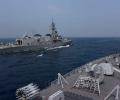
It said that the transit was "ongoing" and that there had been "no interference from foreign military forces so far."

China and the US flexed their naval might by deploying aircraft carriers in a rare showdown in the Taiwan Strait, the narrow channel that separates the Chinese mainland from Taiwan, as Beijing fumed over US House Speaker's meeting with Taiwanese President Tsai Ing-wen in Washington.

For the foreseeable future, the most likely outcome remains continuation of the status quo. Taiwan will remain self-governing without formally declaring independence, while China continues to apply sustained pressure short of war, predict Krishnan Srinivasan and Manoj Mohanka.

The United States has warned China against escalating tensions as Taiwan detected multiple Chinese naval vessels, official ships and balloons operating around the island amid Beijing's large-scale live-fire military drills.

Chinese President Xi Jinping warned US President Donald Trump that mishandling the Taiwan issue could trigger conflicts between the two countries during wide-ranging talks on trade, Iran, and energy security.

China has imposed sanctions on 20 US defence firms in response to the Trump administration's approval of a record USD 11.1 billion arms sales package to Taiwan.

The report evaluates the likely military, strategic and international fallout for China under scenarios ranging from a "major war" to a "minor conflict" with Taiwan, Focus Taiwan said.

The Beijing summit may have reduced immediate diplomatic uncertainty, but it did not resolve the deeper structural contest between the United States and China. That contest appears likely to define the coming decade, notes Varun Arya.

History may remember Takaichi Sanae not as the leader who simply accelerated Japanese rearmament, but as one who governed during Japan's transition from an industrial-age security model to a post-industrial strategic member of the global order, points out Varun Arya.

China on Monday conducted day-long large-scale military drills aimed at surrounding Taiwan by deploying an aircraft carrier group, besides army, navy, air force and missile forces, in an apparent response to Taiwanese President Lai Ching-te's remarks that Beijing has no authority to represent Taipei.

United States and China have agreed that "Iran can't have nuclear weapons," and that the Strait of Hormuz must be opened, according to US President Donald Trump.

US President Donald Trump is set to visit China for talks with President Xi Jinping on trade, global issues, and the Gulf war. The visit aims to address trade frictions and other key issues, with high expectations for progress.

While the Andaman and Nicobar islands serve as a vital, stationary asset for projecting power in the Indian Ocean, referring to them as an unsinkable aircraft carrier ignores key military and geopolitical limitations, explains Commodore Venugopal Menon (retd).

US President Donald Trump received a red carpet welcome in Beijing for talks with Chinese President Xi Jinping on trade, the Iran war, and other key issues. The visit underscores the importance both nations place on their relationship amid ongoing tensions.

US President Donald Trump will visit China from May 13 to 15 at the invitation of President Xi Jinping. The visit occurs amidst global tensions, including the war in West Asia and trade disputes between the US and China. Discussions are expected to cover China-US relations, world peace, and economic issues.

Any miscalculation and miscommunication are fraught with the risk of a major catastrophe, warns Rup Narayan Das.

Donald Trump says several issues were settled during the final day of talks with Xi Jinping covering trade, tariffs, and diplomacy.

The US-China rapprochement, however tenuous, is not without implications for India. Both China and Pakistan have become closer to the US, notes Ambassador T P Sreenivasan.

Foreign Portfolio Investors (FPIs) withdrew nearly Rs 33,000 crore from Indian equities in May, bringing the total outflow for 2026 to Rs 2.25 lakh crore, driven by weak earnings growth, rupee depreciation, and more attractive opportunities in other global markets.

China on Monday dismissed the existence of a 'median line' in the volatile Taiwan Strait after Taiwan's defence ministry said it detected a record 103 Chinese warplanes flying around the self-ruled island in a 24-hour period.

Delhi must now purge the delusional hopes of being a 'counterweight' to China in the US calculus, argues Ambassador M K Bhadrakumar.

'Markets never fully lose hope. But an important shift could come if the Strait remains closed -- moving from high prices to no prices.'

China has increased its antics in Taiwan Strait post the visit of US House Speaker Nancy Pelosi to the self-governed island.

Key to China's decision regarding Taiwan will be its leadership's assessment whether the US will come to Taiwan's defence, explains Jayadeva Ranade, the former senior RA&W officer and China expert.
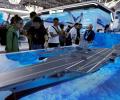
China has commissioned its third aircraft carrier, the Fujian, featuring advanced electromagnetic catapults, amidst rising tensions and military modernization efforts.
US President Donald Trump met with Chinese President Xi Jinping in Beijing to discuss trade, technology, Taiwan, and the Iran war. Xi Jinping said that 2026 will be a 'historic, landmark year' for China-US relations.

The People's Liberation Army's Eastern Theatre Command said the joint military operations around the Taiwan island have been completed successfully, the state-run Global Times newspaper tweeted.

Foreign investors have aggressively sold off Indian equities, withdrawing over 48,213 crore in the first 10 days of April, following a record 1.17 lakh crore outflow in March, driven by escalating geopolitical tensions in West Asia, rising crude oil prices, and global inflation concerns.
US President Donald Trump and Chinese President Xi Jinping met in Beijing to discuss a range of issues, including trade frictions and the war in Iran.
The modern war is about quality over quantity, points out Mihir S Sharma.
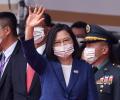
Taiwan on Sunday expressed gratitude to India and several other countries for their calls for exercising restrain and avoiding unilateral actions to change the status quo in the Taiwan Strait in the face of China's belligerent military posturing following United States House Speaker Nancy Pelosi's visit to the island.
On Friday, Taiwan's Defence Ministry said that 68 Chinese military planes and 13 warships crossed over the median line to participate in drills.
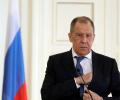
Russian Foreign Minister Sergei Lavrov stated that Russia does not intend to attack Europe, but any attack on Russia would face a devastating response. He also accused the EU's 'war party' of hindering Ukraine peace efforts and pledged support for China on Taiwan.

A White Paper which was released by the Chinese Communist Party on the Taiwan issue read that in order to reunify the island nation into the mainland, Beijing will use force and will turn towards 'armed re-unification'.

As China continue to hold military drills near Taiwan coast after United States House Speaker Nancy Pelosi's recent visit to Taipei, President Tsai Ing-wen has appealed for international support for the island nation and halt the escalation of the regional security situation.
